Why I’ve Always Treated Job Hunting as a Problem to Solve
Over the course of my career, I’ve moved between roles without experiencing the level of difficulty many people associate with job searching. That is not because I have an unusually strong network or because opportunities simply appear. While relationships do matter and I have built them intentionally over time, the more important factor has been mindset.
I have always approached job hunting as a problem-solving exercise.
Once you view it through that lens, the entire process changes. Instead of following the most common path and competing with the largest possible pool of candidates, you begin to look for inefficiencies, alternative routes, and signals that others may ignore.
Most job seekers follow a predictable pattern. They update their CV, submit applications across multiple job boards, and wait for responses. The challenge with this approach is not that it is wrong, but that it is crowded. When thousands of candidates are using the same channels with similar positioning, probability alone makes success harder.
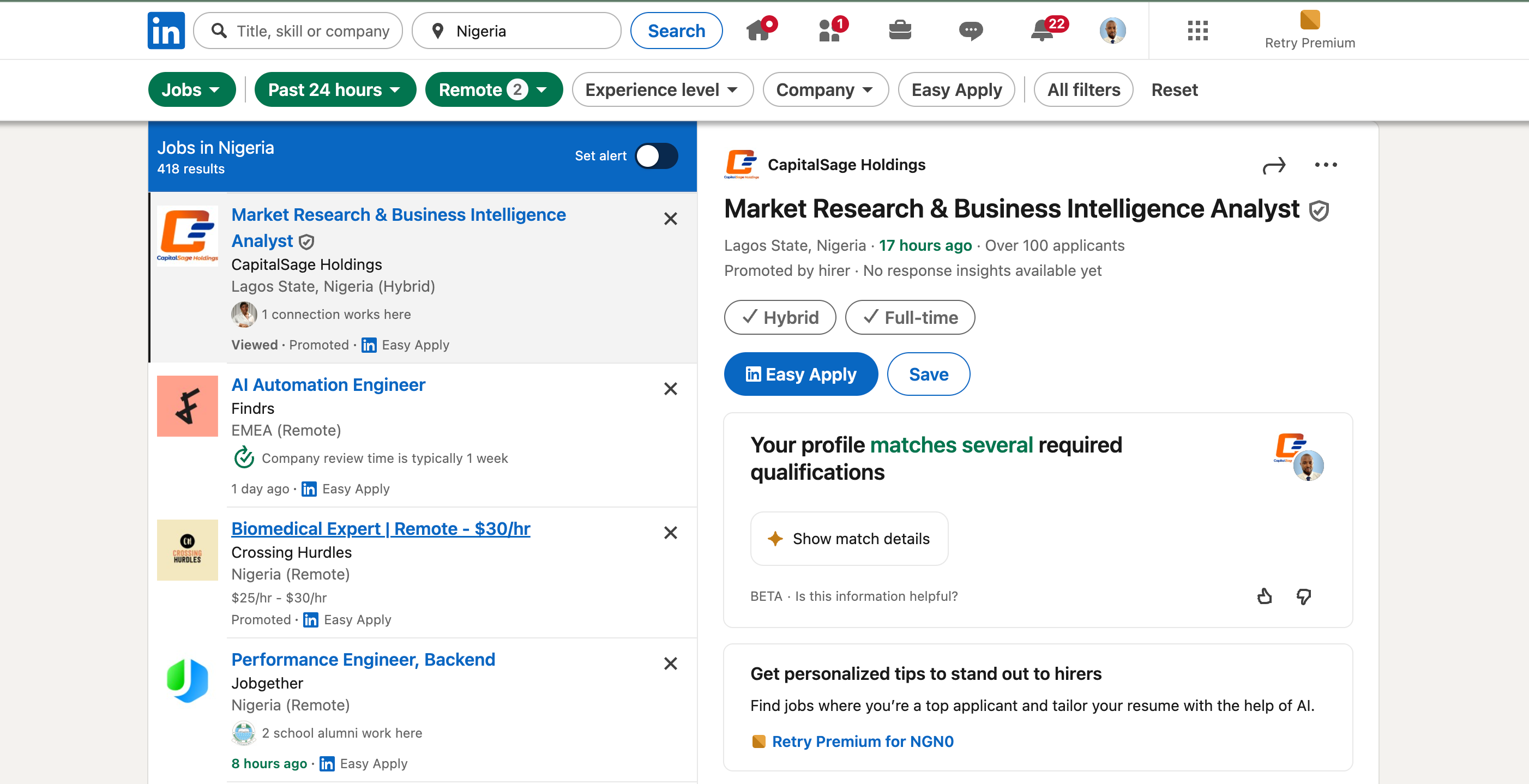
Solving the job search problem requires differentiation.
One of the clearest examples in my career was how I joined OnePipe. I did not discover the company through a recruiter or a job advertisement. Instead, I came across their blog while researching open finance. At the time, I was deeply curious about the space and wanted to understand how APIs and financial infrastructure were evolving. Reading their content gave me two advantages. First, it accelerated my learning. Second, it exposed me to the company before it became widely visible to the broader talent market. Curiosity created proximity, and proximity created opportunity.
A similar pattern appeared when I moved to Ecobank. That opportunity came through Zindi, a data science competition platform. My manager at the time was experimenting with unconventional ways to identify talent. Rather than relying solely on CV screening, he looked at individuals solving real problems on public platforms. This approach reduced hiring risk because demonstrated ability is more reliable than self-reported skill. Participating in that ecosystem positioned me within reach of an opportunity that many candidates would never encounter through traditional applications.
These experiences reinforced a principle that continues to guide me: job searching is an optimization challenge, not an effort challenge. When everyone uses the same strategy, marginal effort produces limited advantage. Changing the strategy itself creates leverage.
This perspective also changes the questions a job seeker asks. Instead of focusing exclusively on where to apply, more useful questions emerge. Where do professionals in this field exchange ideas? Which platforms reveal real skill? What communities or content channels do hiring managers pay attention to? How can skills be demonstrated publicly?
Ultimately, the difficulty many people experience in job searching is not always a reflection of their qualifications. It is frequently a reflection of strategy. Crowded approaches create crowded outcomes. Treating job hunting as a system to analyze and optimize introduces new paths that others may overlook.
And in many cases, those overlooked paths are where the best opportunities live.
About the author
I help teams in fintech, Banking & Finance, and energy build and scale data systems that work in production from pipelines and analytics to models that support real decisions. This blog is where I share practical lessons from that work.
- Say hi: Connect on LinkedIn: I'm always open to conversations about data, analytics, and engineering.
- Consulting: I take on selective work helping organizations build and scale data platforms in Africa and similar markets. If you need a partner on architecture, delivery, or analytics, email me or visit the contact page.